
×

Posts Tagged ‘Further Education’

More sessions added: Free online sessions for post-16 education leaders and practitioners across the Further Education sector

We’re pleased to share an extended programme of professional development opportunities designed for educators, leaders, and practitioners across the FE community. These sessions focus on practical strategies, innovative ideas, and collaborative approaches that support high-quality practice – particularly for teams working with SEND and neurodiverse learners.

All sessions are delivered online via Zoom, and a joining link will be sent to participants once they have registered.

Whether you’re looking to deepen your knowledge, enhance your curriculum design, or develop more inclusive and impactful career pathways, we hope you’ll join us for one or more of these events.

Continuing Professional Development (CPD) sessions: Strengthening Practice Across the FE Community

Our CPD (Continuing Professional Development) sessions are designed to provide colleagues across the FE sector with focused, evidence-based training that enhances inclusive practice, curriculum design, and learner support.

Careers, Preparing for Adulthood & SEND – Preparing Learners for Successful Adult Life

Thursday 12 February – 4-5pm via Zoom

This session is designed for post-16 teams to strategically and operationally embed high-quality, holistic support for learners with Special Educational Needs and/or Disabilities (SEND) as they prepare for adult life. It focuses on enabling meaningful progression into employment, independent living, and active participation in the community.

Click here to book this session

Practical tips for upskilling Further Education practitioners in supporting Neurodiverse Learner’s self-advocacy, reasonable adjustments and workforce readiness

Thursday 5 March – 4-5pm via Zoom

This session look at the strategies trialled and successfully implemented to develop the confidence and self-advocacy skills of neurodiverse learners to prepare for the world of work and the vital role staff play in developing these skills. Participants will take a focused look at how Luminate Education Group trains and develops staff to effectively support neurodiverse learners, including the use of inclusive practice and reasonable adjustments. The session will also consider how these approaches prepare learners for employment, apprenticeships and adulthood, supporting confident transitions into the world of work.

Click here to book this session

Communities of Practice (CoP) Series: Effective Careers Guidance & Information for SEND Learners

Alongside our CPD sessions, we will also host a three-part Communities of Practice series focused on strengthening CEIAG for SEND learners. These sessions are designed to help teams reflect, collaborate, and enhance their approaches across all aspects of careers guidance.

Use of AI for Inclusion: Creating Inclusive Classrooms and Colleges

Tuesday 3 February – 4-5pm via Zoom

Participants will explore how AI can support inclusive Post-16 environments by adapting curriculum materials and college communications to meet diverse learner needs, supporting the Preparing for Adulthood (PfA) agenda. This interactive Bring a Tool or Bring a Question session invites participants to share AI tools that improve accessibility or bring inclusion challenges for collaborative problem-solving.

Click here to book this session

Use of AI for Inclusion: Supporting Learners’ SEND Needs

Tuesday 24 February – 4-5pm via Zoom

The session provides a practical roadmap for strengthening provision across key areas of practice, supporting teams to demonstrate strong, coherent approaches to preparing learners for adulthood. Moving beyond standalone careers education, the session explores how curriculum design, teaching, assessment, and support work together to develop learners’ knowledge, skills, independence, and resilience.

Click here to book this session

Use of AI for Inclusion: Workload, Preparation, and Ethics 

Tuesday 5 March – 4-5pm via Zoom

This session looks at how AI can streamline administrative workloads and session preparation while maintaining the “human touch.” We will also tackle vital ethical considerations – privacy, bias, and transparency – to ensure our use of AI remains safe and aligned with the core values of the Preparing for Adulthood (PfA) framework.

Click here to book this session

How to Register

Places for all sessions can be booked through the Education and Training Foundation (ETF) website. You will be asked to create a free ETF account if you don’t already have one.

The Centres for Excellence in SEND initiative is part of the Universal SEND Services programme, which provides sector-led support to leaders, managers and practitioners to create a step change in inclusive teaching and learning. To access resources and find out more about upcoming activities and support, visit the CfESEND area of the ETF website.
The case for VAT exemption for FE colleges providing education to 16- to 18-year-olds

Further education colleges play a vital role in delivering high-quality education and skills to young people.  There are 693,000 16- to 18-year-olds studying in colleges – more than the number studying in schools (513,000). Students in FE are more likely to come from disadvantaged backgrounds, with 23% of college students having been eligible for free school meals at age 15, compared to just 13% of students attending school sixth forms. Accordingly, colleges are critically important to the Government’s mission of breaking down barriers to opportunity.

Colleges are, however, at a disadvantage. While both colleges and schools are classed as public sector organisations, the way they are treated by the Government is different. Schools are able to reclaim VAT costs from the Government, whereas colleges cannot recover VAT on most of the purchases related to their education activities. This fiscal anomaly reduces the resources available for frontline teaching and learning – especially given that the costs associated with technical and vocational training are significantly higher than those required for academic courses such as A levels. The Association of Colleges estimates that the total annual VAT cost to the college sector amounts to approximately £250 million.

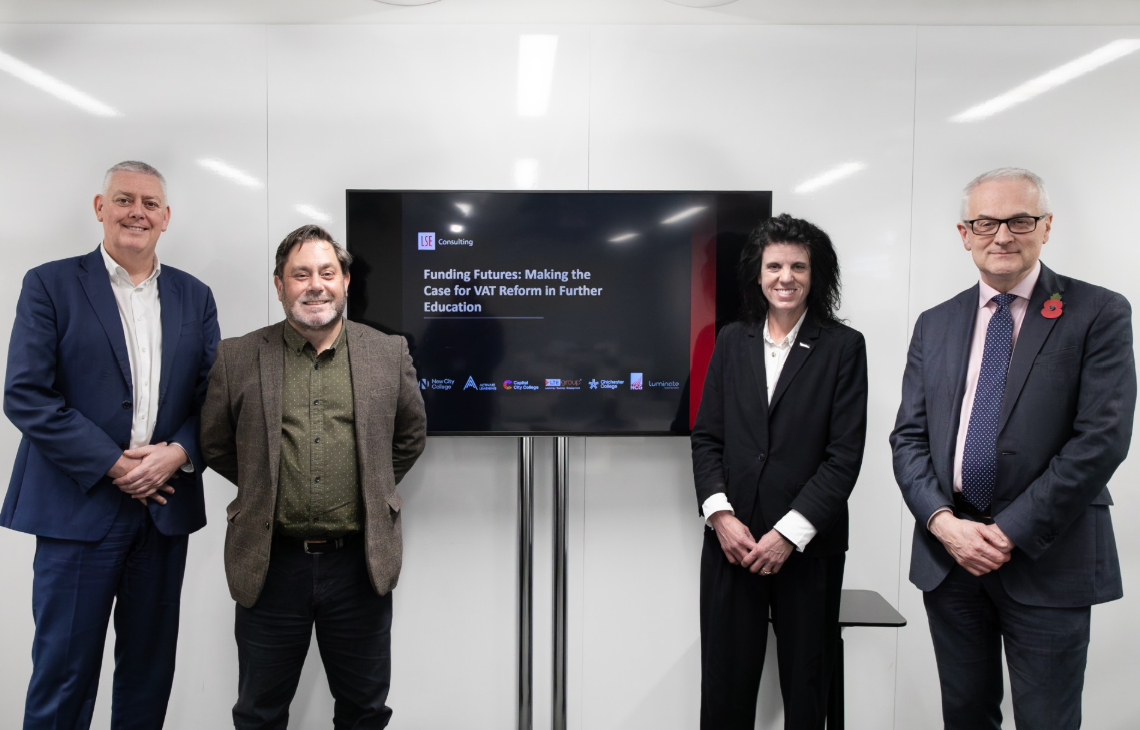
A new research report produced by the London School of Economics in partnership with the Large College Group examines the fiscal and operational impact of the current VAT regime on FE colleges. The analysis suggests that aligning colleges’ VAT arrangements with schools would be fiscally neutral in the medium term for HM Treasury, while unlocking millions in reinvestment for the benefit of students, staff and communities.

One example of this for Luminate Education Group is linked to our recently completed £10.5 million refurbishment of our Park Lane Campus, which accommodates around 2,000 students. The Group incurred just over £2 million of irrecoverable VAT on these refurbishment works. If we had been able to recover this VAT, we would have replaced the whole of the roof and refurbish all of the student toilet facilities.

You can download and read the full report by clicking on the button below.

LSE Report: Executive Summary

  • FE colleges operate as exempt charities, typically incorporated as statutory corporations or charitable companies. While they do not have to pay VAT on some of their activities, many of colleges’ services fall outside the scope of VAT exemption, including commercial lettings (e.g. renting out rooms or sports facilities to third parties), retail sales (e.g. textbooks, stationery not essential to the course), consultancy services, catering services open to the public, hairdressing salons operated as part of training but serving paying customers, and much of the capital expenditure on large-scale building projects to provide industry-standard teaching facilities.
  • The Association of College estimates that the total annual cost of VAT to colleges in England is £250 million. This is funding which ends up in the coffers of HM Treasury rather than being used to support education and training provision.
  • In contrast, schools and academies benefit from the Section 33 VAT refund scheme under the VAT Act 1994, which allows them to reclaim VAT incurred on non-business activities funded by public money. In January 2025, the Government ended the VAT exemption for private schools on education and boarding provision in order to generate additional revenue for state education funding.
  • After the Post 16 Education and Skills Act 2022 became law in November 2022, the Office for National Statistics reclassified colleges as public sector bodies, giving them the same status as schools and academies. However there has been no change in the VAT rules since then. As a result of this anomaly colleges remain forced to repay millions of pounds each year which could otherwise be used for improving facilities for students or recruiting and retaining teaching staff with the industry experience needed to train the next generation of skilled employees the UK economy needs.
  • This creates a real financial impact, as VAT becomes a net expense that reduces FE colleges’ available budgets for investment, expansion and student services, compared to universities and schools.
  • As a result of the VAT rules, FE colleges are less competitive and have fewer resources available for improving facilities, hiring staff or supporting disadvantaged students. The VAT disadvantage has become more pronounced as public funding for FE colleges has tightened over the past decade (Institute for Fiscal Studies, 2023).
  • The absence of VAT recovery mechanisms for FE colleges in England contrasts with international practices where vocational and independent education are treated as legitimate public goods deserving of fiscal support. Extending VAT exemptions or refund rights to FE colleges would not be anomalous, but rather aligned with international norms aimed at supporting inclusive and efficient education systems.
  • The LSE researchers’ simulation of a VAT rebate on capital investment, using a sector-specific refund mechanism limited to FE and sixth-form colleges similar to the arrangements introduced for academies in 2011, suggests that such a reform could be fiscally neutral over a 10-year period, while delivering significant benefits in terms of educational outcomes and regional development.
  • Current VAT policy discourages capital investment and undermines financial resilience. Aligning the fiscal treatment of FE colleges with that of schools and universities is both a matter of equity and of sound economic policy. Removing these distortions would not only improve the efficiency of public investment in education, but also signal a clear commitment to supporting skills development across all regions and social groups. In doing so, it would help unlock the full potential of the UK’s FE sector as a driver of inclusive growth.

Website designed and built by Web Phizix